






Pick your turtle: a TMNT Commander playstyle guide
Pick your turtle: a TMNT Commander playstyle guide
The TMNT Commander set has 15+ legendary creatures across a precon and a full main set. Before you buy anything, figure out which one matches how you actually play.
This is a set built around choosing your character. The precon's Character Select mechanic asks you to pick two commanders, and your pairing determines your entire strategy. The main set adds a villain arc, a Rat tribal engine, a 7/7 that cheats creatures into play, and a 1/1 that ends games. There's something here for everyone. The job is finding yours.
If you already know your EDHMatch player type, skip straight to your section. If you don't, take the quiz first.
Character Select is a personality test
Character Select works like partner with a twist. You pick two commanders that both have "Partner — Character Select," and they share a color identity. All six options in the precon are individually mono-colored, but paired together they open up WUBRG.
The roster:
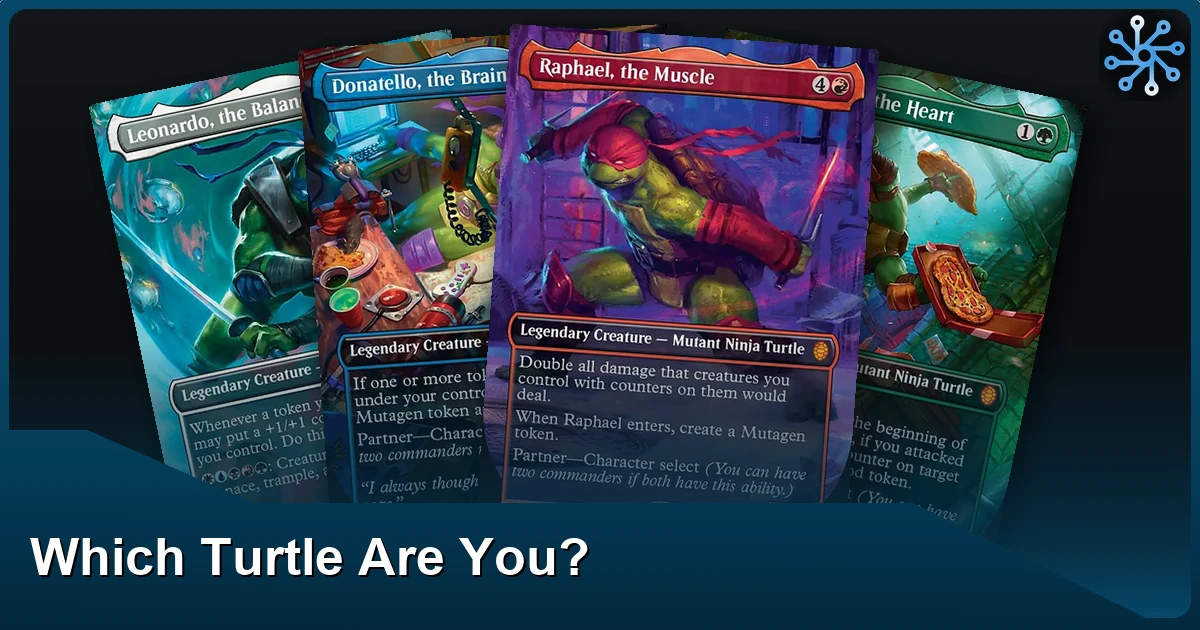
Leonardo, the Balance is the linchpin. Whenever a token enters under your control, he puts a +1/+1 counter on each creature you control (once per turn). His five-color activation gives your whole board menace, trample, and lifelink. He pairs with any of the other four turtles or Splinter.
Donatello, the Brains adds a Mutagen token to every token batch you create. One Hordeling Outburst becomes three goblins and three Mutagen tokens.
Splinter, the Mentor creates a Mutagen token whenever a nontoken creature you control leaves the battlefield. Deaths, bounces, blinks — Splinter profits from all of it.
Raphael, the Muscle doubles all damage from creatures with counters on them. He also enters with a Mutagen token.
Michelangelo, the Heart puts a +1/+1 counter on a creature and creates a Food token after every combat where you attacked.
Heroes in a Half Shell is the standalone option. A 5/5 with vigilance, menace, trample, and haste that draws a card and puts +1/+1 counters on your Mutants, Ninjas, and Turtles whenever they deal combat damage to a player. It's leading the precon at 864 EDHREC decks for a reason.
What are Mutagen tokens? Artifact tokens you tap, sacrifice, and spend one mana on to put a +1/+1 counter on a creature — sorcery speed only. They're the fuel connecting every pairing to Leonardo's counter engine.
Which turtle are you?
The Architect: Leonardo + Donatello
Leonardo, the Balance paired with Donatello, the Brains is the most engine-oriented pairing in the precon. Donatello adds a Mutagen token to every token batch. Leonardo triggers off every token entering. The math compounds fast.
What the engine looks like
Deploy Donatello on turn 2, Leonardo on turn 3, and the engine's running. Every token you create from here forward brings an extra Mutagen, and each one entering triggers Leonardo's once-per-turn counter.
Here's the Architect's puzzle: Leonardo only triggers once per turn. So you want token creation spread across every turn, not just yours. Smothering Tithe on opponents' turns. Bitterblossom on your upkeep. Grudge Keeper when creatures die.
Distribute your triggers across the turn cycle and the counters stack quietly. By turn 7-8, your board looks unassuming. Small tokens, a few counters. Then you activate Leonardo's five-color ability (menace, trample, lifelink on everything) and three opponents suddenly need to recalculate their blocks.
If you like Atraxa, Ghave, or Chatterfang, this is your pairing.
| Card | Why it works |
|---|---|
| Mondrak, Glory Dominus | Doubles token creation. With Donatello, you're tripling Mutagen output. |
| Anointed Procession | Same doubling effect in white. Stacks with Mondrak. |
| Smothering Tithe | Creates Treasure on opponents' turns, triggering Leonardo outside your turn. |
| Bitterblossom | Token on every upkeep. Consistent off-turn Leonardo trigger. |
Hidden gem: Inspiring Call. Draws a card for each creature with a +1/+1 counter and gives them all indestructible until end of turn. In this deck, that's your entire board for two mana, plus six cards in hand. Almost nobody runs this.
The Spike: Leonardo + Raphael
Leonardo, the Balance paired with Raphael, the Muscle is raw damage math. Leonardo puts counters on everything. Raphael doubles all damage from creatures with counters. A 3/3 with two +1/+1 counters swings for 10.
The kill clock
Raphael arrives on turn 4-5 with an ETB Mutagen token. If Leonardo's already on board, that Mutagen entering triggers a counter on each creature you control. Now every creature deals double.
Three creatures with two counters each deal 30 damage instead of 15. Add Leonardo's five-color activation for menace and trample, and you're threatening to eliminate a player by turn 6-7.
You will be the archenemy. Run Heroic Intervention, Teferi's Protection, and Flawless Maneuver, or accept the target and close games before the table coordinates.
If you recognize this play pattern from Xenagos, Jetmir, or Karlach, that's the family this deck belongs to.
| Card | Why it works |
|---|---|
| Hardened Scales | Extra +1/+1 counter on every placement. One mana. |
| Branching Evolution | Doubles counters when placed. Turns Leonardo's trigger into twice the output. |
| Heroic Intervention | Two-mana board protection for when the table coordinates against you. |
| Roaming Throne | Choose Turtle — doubles both commanders' triggered abilities simultaneously. |
Hidden gem: Dolmen Gate. Your attacking creatures can't be dealt combat damage. In a deck where you need countered-up creatures to connect without trading, this removes the biggest blocking disincentive. Most players overlook it and then wonder why their threats keep getting chump-blocked.
The Diplomat: Splinter + Leonardo
Splinter, the Mentor paired with Leonardo, the Balance is the political grinder. Splinter creates a Mutagen token whenever a nontoken creature leaves the battlefield under your control. In a four-player game, creatures die constantly. Splinter turns the table's natural churn into your advantage without you doing the killing.
Playing the long game
Splinter comes down on turn 2 for two mana. Creatures die from normal gameplay. Each death creates a Mutagen, and those Mutagens feed Leonardo's counter engine once he arrives on turn 3-4.
The political angle: opponents hesitate to remove Splinter because killing him creates another Mutagen. That hesitation is your best tool.
Make deals. Redirect aggression. Point threats at each other. By turn 7-8, you've got the biggest board at the table while everyone else spent resources fighting.
The play pattern mirrors Teysa Karlov, Meren, and Marchesa: profit from death without being the one who caused it.
| Card | Why it works |
|---|---|
| Grave Pact | Your creatures dying forces opponents to sacrifice too. More deaths, more Mutagens. |
| Zulaport Cutthroat | Drains on every death. Pairs cleanly with Splinter's token economy. |
| Dictate of Erebos | Flash-speed Grave Pact. Drop it before a board wipe. |
| Phyrexian Tower | Free sacrifice outlet. Trigger Splinter whenever convenient. |
Hidden gem: Killing Wave. For each creature, its controller pays X life or sacrifices it. In a politics deck, you control the X and watch opponents make impossible choices: save their best creature at a steep life cost, or let Splinter's trigger fire for every creature that dies. Almost everyone forgets this card exists.
The Brawler: Michelangelo + Leonardo
Michelangelo, the Heart paired with Leonardo, the Balance is snowball aggro. Attack, get a +1/+1 counter and a Food token. Leonardo triggers off the Food entering and puts a counter on each creature you control. Next combat, everything swings harder. No setup required.
Building momentum
Michelangelo costs two mana and has trample. He's attacking on turn 2. Every combat where you connect, he places a counter and creates Food. Leonardo sees the Food enter and counters your whole board. Two triggers from one attack step, every turn.
The Food tokens double as insurance. Life total pressure is real in multiplayer, and the Food keeps you above the danger line while your board compounds. You're not racing to a combo. You're grinding the table down through the combat step, and each swing makes the next one more dangerous.
If you play Isshin, Adeline, or Najeela, you already know this pattern: attack as engine, not just payoff.
| Card | Why it works |
|---|---|
| Champion of Lambholt | Grows with every counter placed. Makes your creatures unblockable once she's big enough. |
| Vigor | Damage to your creatures becomes +1/+1 counters instead. Attack freely. |
| Unnatural Growth | Doubles power and toughness on your turn. Absurd with existing counters. |
| Inspiring Call | Card draw and indestructible for your countered-up board. |
Hidden gem: Garruk's Uprising. All your creatures have trample, and you draw a card whenever a creature with power 4 or greater enters under your control. In a deck that stacks counters, your board clears that threshold within a few turns and starts drawing cards on top of trampling through.
Where's the Vorthos pick?
This is a Universes Beyond set. That changes things for flavor-first players.
If you're a Vorthos who grew up with the Turtles, Character Select might be the most satisfying mechanic in years. Picking Leonardo + Raphael isn't a power choice — it's the character dynamic. Splinter mentoring the turtles, Michelangelo creating Food tokens while raiding the fridge, Donatello obsessively creating Mutagen. The flavor hits.
But if you're a Vorthos who cares specifically about Magic's lore, this set lands differently. No Dominaria, no planeswalker spark, no Magic world woven into the design. The mechanics work, but the world isn't Magic's world. You might love it for the IP execution. Or you might skip it entirely because it's not Magic. Both positions are valid, and we're not pretending the tension doesn't exist.
If UB fatigue is hitting you, the main set has options worth building around on mechanics alone. Rat King, Verminister and Super Shredder are interesting enough to evaluate without caring about the IP. And if you need a Magic-native world to care about a commander, this set probably isn't going to change that.
Beyond the precon: commanders for other playstyles
The main set has 15+ legendary creatures beyond the precon roster. Five stand out for what they do and who they're for.
The sleeper: Super Shredder
Super Shredder is the set's breakout card. A 1/1 with menace for two mana, he gets a +1/+1 counter whenever any permanent leaves the battlefield. Not just yours.
That distinction is what the market figured out. In a four-player game, permanents leave constantly: fetch lands crack, removal resolves, board wipes happen, creatures trade. Super Shredder grows on all of it without you lifting a finger. By turn six in a typical game, he's usually somewhere between 12/12 and 15/15.
Menace means he needs two blockers to stop. A 14/14 with menace needs two creatures that can survive 7+ power hitting them, and in most games, that's a real problem to solve.
The best builds lean into the "permanents leaving" text deliberately: fetch lands, Wasteland, Vampiric Rites, Yawgmoth, Thran Physician. Every decision you make accelerates the clock. He fits Spike players who want a commander that scales with game length, and Timmy players who want to watch a 1/1 become the biggest thing at the table.
| Card | Why it works |
|---|---|
| Yawgmoth, Thran Physician | Sacrifice engine and draw; every activation creates another counter on Shredder |
| Contamination | Locks opponents off colored mana; requires sacrifice, which this deck already does |
| Bolas's Citadel | Cast permanents from the top by paying life; permanents that later leave the battlefield each trigger Shredder |
| Crypt of Agadeem | Mana burst after creature deaths; classic mono-black engine piece |
Hidden gem: Soldevi Adnate. Tap and sacrifice a black or artifact creature to add black mana equal to its mana value. Super Shredder's mana cost is , so his mana value is 2, which means you can sacrifice him for 2 black mana, rebuy him from the command zone, and keep the engine moving. Almost nobody knows this card.
If you build around one weird line of text: Rat King, Verminister
Rat King, Verminister is a two-mana 1/1 that looks like nothing. Disappear checks at your end step: if one of your permanents left the battlefield this turn, create a 1/1 Rat token and put a +1/+1 counter on Rat King. But the real ability is the tap: sacrifice 3 Rats to return a creature card and all copies of it from your graveyard to the battlefield.
"All copies" is the templating you almost never see. Fill the graveyard with Rat Colony through Stitcher's Supplier, Mesmeric Orb, and Buried Alive. Spend turns 3-5 looking like a non-threat. Then tap, sacrifice 3 Rat tokens, target one Rat Colony, and sixteen copies come back. Each Rat Colony gets +1/+1 for each other Rat in play.
680 decks on EDHREC by prerelease day. It's one of the best deals in the set if you want a Johnny build-around.
| Card | Why it works |
|---|---|
| Stitcher's Supplier | Mills 3 on entry and on death; fills the graveyard with Rat Colonies fast |
| Mesmeric Orb | Self-mill every time anything taps; ongoing fuel without needing combat |
| Marrow-Gnawer | Tap and sacrifice a Rat: create tokens equal to your Rat count; generates the sacrifice fodder on demand |
| Haunted Crossroads | Put a creature from graveyard on top of library at upkeep; lets you set up the Rat Colony loop |
Hidden gem: Phyrexian Reclamation. Pay two mana and 2 life to return a creature from your graveyard to your hand. After your mass reanimation gets answered, this lets you rebuild the graveyard pile at instant speed for very little.
If you want trigger-stacking: Splinter, Radical Rat
Splinter, Radical Rat doubles every triggered ability of Ninja creatures you control. That's a Panharmonicon effect, but specifically for Ninjas. In a deck full of creatures with Ninjutsu and Sneak, "enter the battlefield" triggers fire every single attack.
Most Ninja ETB triggers are already strong: draw cards, deal damage, put counters, create tokens. Double them. The main set's Sneak mechanic feeds directly into this: return an unblocked attacker to your hand, cast a Ninja for its Sneak cost, that Ninja's ETB fires twice, then you have the original creature back in hand to enable next turn's Sneak. The whole loop sustains itself by turn four.
671 EDHREC decks, within nine of Rat King, statistically tied. If you want a Ninja tribal engine and you've played Yuriko before, this is the natural evolution.
| Card | Why it works |
|---|---|
| Yuriko, the Tiger's Shadow | Top-end Ninja payoff; her trigger deals damage equal to converted mana cost and it fires twice |
| Higure, the Still Wind | Tutors for any Ninja when it deals combat damage; triggers twice, so it finds two Ninjas |
| Prosperous Thief | Creates Treasure on Ninjutsu; doubled trigger creates two Treasures per attack |
| Fallen Shinobi | Exiles two cards from the defending player's library on damage; doubled fires on both opponents' turns |
Hidden gem: Throat Slitter. Destroys a nonblack creature when it deals combat damage to a player, no questions asked. With Splinter, that's two creatures gone per connection. Consistently underplayed in Ninja decks and brutally efficient once you see the math.
If you just want to turn creatures sideways: Raph & Mikey, Troublemakers
Raph & Mikey, Troublemakers is a seven-mana 7/7 with trample and haste. Whenever it attacks, you reveal cards from the top of your library until you hit a creature, put it onto the battlefield tapped and attacking, then put the rest on the bottom of your library in a random order.
Cast a 7/7 haste, attack, flip a creature for free. Hit Blightsteel Colossus, and the game is probably over. Hit a mana dork, try again next turn.
672 decks on EDHREC, up from 489 before prerelease weekend. Clearly the deck people wanted to build once they had cards in hand. It's the most accessible commander in the set and plays exactly as stated.
| Card | Why it works |
|---|---|
| Blightsteel Colossus | Infect and trample; this is the dream flip |
| Selvala's Stampede | Each player votes, then you either put a creature from hand or library into play; both paths work |
| Sneak Attack | One red mana: put any creature into play haste; feeds into the attacker-that-reveals-the-next-attacker loop |
| Garruk's Horde | Play with the top card of your library revealed; you can cast creature spells from the top any time you could normally cast them, at full cost — a slower, continuous version of the Raph & Mikey effect |
Hidden gem: Tempt with Vengeance. Create X 1/1 Elemental tokens with haste. Each opponent can create X more for themselves. If they don't take the deal, you just got a free attack with X hasty creatures. If they do, the political fallout is usually interesting. Cheap, impactful, and forgotten.
If you want a villain arc: Shredder, Shadow Master
Shredder, Shadow Master creates non-legendary token copies of himself that attack each other opponent when he swings. Each token that connects makes that player lose half their life, rounded up. In a four-player pod, one attack step threatens 60 damage across three opponents.
(The math: Shredder hits player 1 for half their life. Copies hit players 2 and 3 for half their life. If everyone's at 40 life, that's 20 per opponent before commander damage.)
The deck wants evasion, protection, and ways to untap for a second swing. Swiftfoot Boots and Lightning Greaves get Shredder active safely. Strionic Resonator copies the "create copies" trigger, which means four copies attacking four opponents instead of three. Get him through twice and players are dead regardless of life total — the ability is life loss, not damage, so prevention and lifegain can't stop it.
| Card | Why it works |
|---|---|
| Lightning Greaves | Free equip, haste, shroud; the floor for keeping aggressive commanders alive |
| Strionic Resonator | Copies the "creates copies attacking each opponent" trigger; in a four-player game, that doubles from two token copies to four — two more life-loss triggers against the same opponents |
| Reconnaissance | Untap attackers after damage; Shredder deals damage, untaps, and dodges blocks |
| Assault Suit | Shredder attacks each combat and can't be sacrificed; during other players' turns, opponents gain control of him and attack with him, adding pressure to the table |
Hidden gem: Assault Suit. It's already in the table above because it deserves the emphasis. During an opponent's turn, Shredder attacks on their behalf. Shredder's trigger fires and copies enter the table, threatening the other opponents. The attacking player controls those copies, not you, but you keep Shredder at the end of their turn and the board state gets chaotic fast. Consistent multi-player pressure from a single equipment is the deal.
If you already own an artifact shell: Krang, Master Mind
Krang, Master Mind costs 8 mana but has affinity for artifacts, so with Sol Ring, Arcane Signet, and two other rocks on board, you're casting him for four mana. On ETB, draw cards equal to the difference between four and your current hand size, but only if you have fewer than four cards in hand. He gets +1/+0 for each other artifact you control.
The competitive community decided 6UU is too much even with affinity. Fair. But for the Commander player who already owns an Urza or Emry artifact shell, Krang is a value commander that tops your hand up to four cards and happens to become a 12/4. That's a reasonable floor.
The build path is clear: affinity enablers, mana rocks, artifact payoffs, and ways to protect and recur Krang after removal. Breya and Daretti shells convert cleanly. No infinite combos required. Just honest artifact beats.
| Card | Why it works |
|---|---|
| Thought Monitor | Flying affinity creature that draws two cards on entry; same math as Krang |
| Sai, Master Thopterist | Creates a 1/1 Thopter per artifact cast; converts your ramp into an army |
| Mystic Forge | Cast artifacts from the top of your library; Krang's affinity math starts to compound |
| Shimmer Myr | Cast artifacts at instant speed; converts your hand into interaction during opponents' turns |
Hidden gem: Dispatch. One-mana exile removal with metalcraft. In an artifact deck, metalcraft is always online. This is better than Swords to Plowshares in your deck specifically, and almost nobody building Krang runs it yet.
TMNT cards worth picking up for any Commander deck
You don't have to be building a TMNT commander to want some of these.
Super Shredder is the chase card. A 1/1 that becomes a 14/14 in a normal game by turn six, with menace. If you're building mono-black and you want a commander that scales with game length without requiring dedicated setup, this is it.
Splinter's Technique is an unconditional tutor at four mana, or two mana with Sneak if you have an unblocked attacker. Most black decks attack sometimes. This replaces Diabolic Tutor in almost any list. Multi-format legs (Legacy is paying attention) give it a real price floor.
Cool but Rude is a red Class enchantment. Level 1 lets you draw and discard on attack. Level 2 deals 2 damage to each opponent every time you discard, with no cap. Madness, cycling, Hollow One, Loot Scooter decks all want this. MTGGoldfish called it "absurd" in Standard. Commander has a more forgiving setup bar.
Sewer-veillance Cam is a one-mana common getting competitive attention. Combined with Goblin Welder and a mana rock in the graveyard, it creates an infinite mana loop. If you're running Goblin Welder anywhere, check whether the Cam fits your list.
Should you buy the precon?
The "Turtle Power!" precon is available at standard precon pricing.
What you get: a functional five-color deck with Character Select, giving you 10+ distinct commander pairings from one box. The manabase is serviceable but not great. Too many taplands. The counter and token theme is coherent and upgradeable.
Power level: B-tier precon. Plays fine at casual tables out of the box. Won't threaten focused builds without upgrades. Character Select's replay value is the real selling point.
Who should buy it: you like TMNT and you play Commander. The IP execution is strong, and the upgrade paths are clear for every pairing. If the IP doesn't matter to you, individual singles offer better value for specific builds, and Splinter's Technique and Rat King are both easy pickups right now.
Best upgrade path by player type:
- Architects: Mondrak, Anointed Procession, Smothering Tithe
- Spikes: Hardened Scales, Branching Evolution, Dolmen Gate
- Diplomats: Grave Pact, Dictate of Erebos, Phyrexian Tower
- Brawlers: Champion of Lambholt, Vigor, Garruk's Uprising
Full release is March 6. Take the EDHMatch player type quiz if you haven't, then come back and read your section.