






Which Lorwyn Eclipsed commander matches your playstyle?
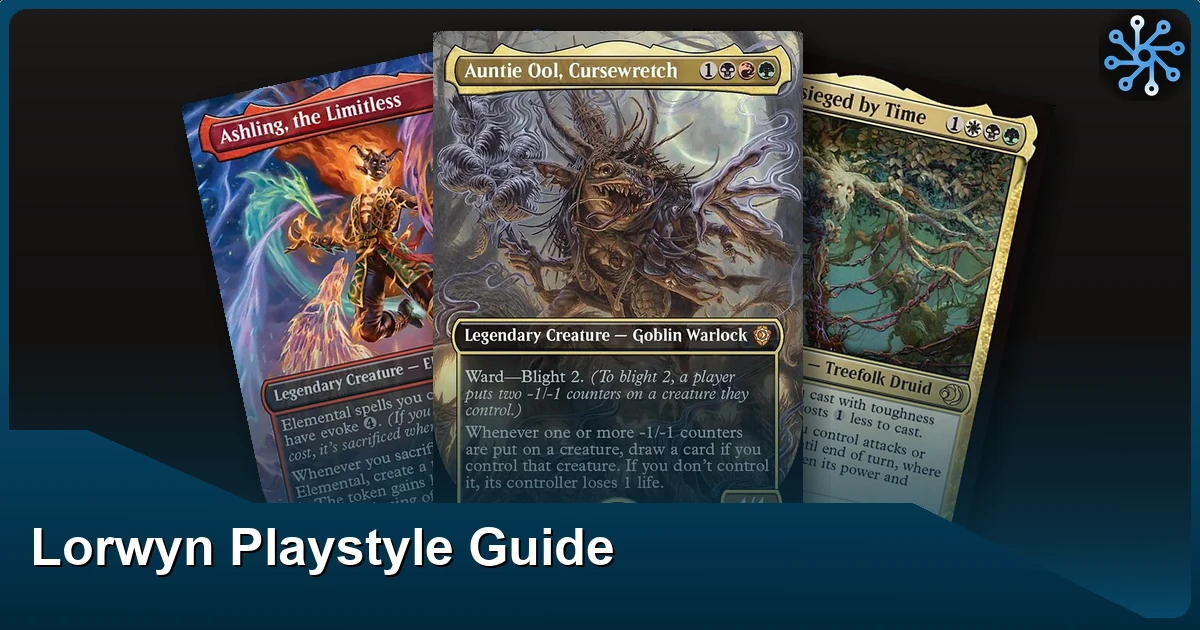
Which Lorwyn Eclipsed commander matches your playstyle?
The return to Lorwyn gives every player type a new home
Lorwyn Eclipsed dropped on January 23, 2026, 18 years after the original block. It's a 408-card set with 22 new legendary creatures, and its design is doing something the power rankings won't tell you: it's building player identity into the cards themselves.
What makes this set different
The signature mechanic is blight N, paying N -1/-1 counters on creatures you control as a spell cost. It doesn't target. You can't split counters. You can even overblight (killing the creature) if the effect is worth it. The set was designed with zero +1/+1 counter cards in the main set specifically to prevent confusion, which matters a lot once you start mixing with the rest of your collection.
Evoke returns on five mythic Elemental Incarnations, each with two ETB abilities gated behind colored mana. Hard-cast for both effects, evoke for one on the cheap. And critically, blinking or reanimating them triggers neither effect. That's a deliberate correction from the grief-and-fury days of Modern Horizons 2.
How the transform mechanic creates real identity
Seven of the main-set legendaries are double-faced transform commanders. Each flips between a Lorwyn (light) side and a Shadowmoor (dark) side by paying one off-color mana at the beginning of your first main phase. Once per turn.
But the flip timing creates a genuine decision point every turn: which version of your commander does this board state need right now? That's less of a rules question and more of a personality question. And it's where this set gets interesting for player identity.
Timmy's dream: Ashling, the Limitless and Elemental spectacle
Ashling is the ideal Timmy commander. She's a 2/3 five-color Elemental Sorcerer who only costs to cast, and she gives all Elemental permanent spells you cast from hand evoke . Whenever you sacrifice a nontoken Elemental, you get a hasty token copy that sticks permanently if you pay WUBRG at end step.
How the evoke-copy engine creates the biggest board states in Commander
Turn 4, Ashling hits the board. Turn 5, you evoke Mulldrifter for , draw 2, sacrifice it, get a hasty copy that draws 2 more. Then evoke Shriekmaw, destroy a creature, copy it, destroy another. By turn 6, you've got a board full of token copies of massive Elementals, all with haste, threatening to stick around forever the moment you announce "pay WUBRG, keep everything."
With Risen Reef out, every Elemental ETB draws a card or drops a land. Every token copy triggers it again. This is the baseline, not Christmas land. Ashling games reliably look like this by turn 6, which isn't something most 5-color commanders can claim.
The downside? You become the archenemy fast. Five-color mana is fragile. The strategy is fairly linear (evoke, copy, repeat). If creative expression matters more than spectacle, Ashling might not be your commander. But if you want to overwhelm the table with the sheer weight of your board state, she's your pick.
10 cards that make Ashling tick
| Card | Why it works |
|---|---|
| Risen Reef | Triggers on every Elemental ETB, goes nuclear with token copies |
| Incandescent Soulstoke | Cheats Elementals in, then sacrifices them for the copy trigger |
| Mulldrifter | The iconic evoke Elemental; draw 2, copy, draw 2 more |
| Shriekmaw | Evoke for removal, copy for a second kill, keep the 3/2 fear body |
| Kindred Discovery | Draws whenever any Elemental enters or attacks, absurd with copies |
| Maelstrom Wanderer | Double cascade Elemental; evoke for , cascade twice, get a copy |
| Omnath, Locus of Rage | Landfall Elemental tokens that Lightning Bolt on death |
| Horde of Notions | Casts Elementals from your graveyard, original Lorwyn nostalgia |
| Cavalier of Thorns | Mills 5, reanimates a land, mills 3 more on death; double with Ashling |
| Titania, Protector of Argoth | Elemental payoffs with land sacrifice for 5/3 tokens |
Budget pick: Tornado Elemental. Evoke it with Ashling, deal 6 damage to all flying creatures, get a hasty 6/6 copy that deals 6 more. Twelve damage to the air for a couple mana, and almost nobody runs it.
Jenny's puzzle box: Grub, Storied Matriarch and breaking blight tokens
Grub is an invitation to break the rules. Her front side (Lorwyn) returns a Goblin from your graveyard to hand on enter or transform. Her back side (Shadowmoor, Notorious Auntie) lets you optionally blight a creature when Grub attacks — put a -1/-1 counter on it as a cost — and then creates a tapped, attacking token copy of that blighted creature. The copy gets sacrificed at end of turn. If you're a Johnny/Jenny, that last clause is where the deckbuilding starts.
Three creative builds that make Grub play completely differently
The "sacrifice at end of step" trigger is a puzzle. Three solutions, each producing a different deck:
The Sundial build. Sundial of the Infinite ends the turn before the sacrifice trigger resolves, keeping copies permanently. The kind of interaction that makes the table pause and reread the card.
The sacrifice outlet build. Goblin Bombardment sacrifices the copies before they'd die anyway, converting them into damage. You're not keeping the creatures. You're converting them into 1 damage per creature, repeatedly, each combat. It's a slower burn, but it never requires the Sundial to be in hand.
The blink build. Conjurer's Closet blinks copies into permanent versions. More mana, more setup, but the payoff is blinking a copy of your best Goblin into a permanent card that's now yours forever. The deck plays more like a flicker midrange build than traditional Goblin tribal.
Each of these is a fundamentally different deck built from the same commander.
The Sundial trick and other interactions that reward creative deckbuilding
The Grub interaction space goes deeper than Sundial. Every attack step is a real choice: which creature do you blight? The token copies whoever you choose, taps and attacks, then dies at end of turn — unless you stop that from happening.
Early turns with Grub cycle between her two sides: Lorwyn recovering key Goblins like Goblin Recruiter or Sling-Gang Lieutenant, Shadowmoor creating attacking copies. The creative tension is in the choice. Blight a 1/1 token to copy your best creature? Blight a creature with a strong ETB so the token triggers it again on attack? Every combat becomes a decision tree.
Meek Attack fits all three builds. It's a Sneak Attack variant that cheats creatures in for a turn, but with Grub's copying and Sundial tricks, "a turn" is negotiable. MTG Rocks called it the set's most wildly underrated card. Hard to argue.
Spike's tournament weapon: Auntie Ool and why -1/-1 counters are the new card advantage
Auntie Ool already has cEDH tournament results. She's a 4/4 BRG Goblin Warlock for . Ward costs opponents blight 2 (they place -1/-1 counters on their own creatures to target her). Whenever -1/-1 counters land on your creatures, draw a card. Whenever they land on opponents' creatures, opponents lose 1 life.
Her single mechanic generates cards, mana advantage, and life drain at the same time.
The cEDH combo lines that already won tournaments
Line 1: Devoted Druid + Luxior, Giada's Gift. Devoted Druid untaps by placing a -1/-1 counter on itself. Each untap draws a card via Ool. Luxior removes the size restriction. Infinite mana and infinite card draw in one package.
Line 2: Necrotic Ooze + Devoted Druid + Morselhoarder in graveyard. Ooze gains both activated abilities. Morselhoarder's ability removes -1/-1 counters to produce mana. Combine with Druid's untap ability. Infinite.
Line 3: Yawgmoth, Thran Physician + two persist creatures. Sacrifice one, put a -1/-1 counter on the other (drawing a card with Ool), persist returns the first. Loop. Each iteration draws a card and drains life with Blood Artist.
What makes Ool different from most combo commanders is the redundancy. She converts every blight effect, persist trigger, and wither interaction into card draw. You don't need to find the exact combo. You need any -1/-1 counter effect, and Ool makes it profitable.
How to tune Ool from casual grind to competitive kill
The casual version leans into the grind: Black Sun's Zenith wipes the board and draws cards, Midnight Banshee steadily drains opponents each upkeep, Contagion Engine proliferates twice per activation. These games end slowly, with Ool accumulating advantages until nobody has resources left to fight.
The cEDH version compresses to turns 2-4 with fast mana and tutors. You're not playing Midnight Banshee. You're playing Vampiric Tutor to find Devoted Druid and winning before the table stabilizes.
The tuning question is honest: what power level is your pod? Ool scales cleanly in both directions, which is why her EDHREC adoption is nearly 10,000 decks and climbing.
| Card | Why it works |
|---|---|
| Yawgmoth, Thran Physician | Sacrifice + counters + draw; goes nuclear with Ool |
| Flourishing Defenses | Creates 1/1 tokens whenever -1/-1 counters are placed |
| Contagion Engine | Proliferates twice; explicitly called "missing" from the precon |
| Devoted Druid | Untaps by placing a -1/-1 counter; each untap draws with Ool |
| Blowfly Infestation | When a counter-bearing creature dies, spread the counter, infinite loops |
| Nest of Scarabs | Insect tokens on every counter placement; redundancy for Flourishing Defenses |
| All Will Be One | Every counter placement deals direct damage; combo finisher |
| Black Sun's Zenith | Scalable board wipe that shuffles back; mass card draw with Ool |
| Evolution Sage | Proliferates on every landfall |
| Midnight Banshee | Steady upkeep engine that drains every non-black creature slowly |
Sleeper card: Wickersmith's Tools (ECC). Puts a charge counter on itself every time -1/-1 counters hit any creature. Doubles as a mana rock. Eventually cashes out as a burst of Scarecrow tokens. With Ool out, every counter event that charges this artifact also draws you a card — it's quietly accumulating advantage every time you do anything.
Vorthos walks among ancient trees: Doran, Besieged by Time and the flavor of endurance
Doran is a returning character. He appeared in the original Lorwyn block in 2007 and has been absent for 18 years.
The name "Besieged by Time" carries real weight here. An ancient Treefolk who endured while the plane cycled between light and dark, finally marching again. Every card in the deck can be chosen for flavor, and the mechanical identity couldn't be more on-theme: slow, ancient, enduring, devastating when they finally move.
Building a Treefolk deck that tells Lorwyn's 18-year story
Doran is a 0/5 for . Each creature spell with toughness greater than power costs less. Whenever a creature you control attacks or blocks, it gets +X/+X where X is the difference between toughness and power. A 0/5 attacks as a 5/10. A 0/8 swings for 8 damage.
The mana curve works naturally as a flavor piece. Doran leads the grove. Sapling of Colfenor, Timber Protector, and Treebeard fill the ranks. Ancient creatures, all. Opponents who haven't read your cards tend to ignore a board full of 0-power creatures, and then your 0/5s swing for lethal.
Treebeard, Gracious Host is seeing heavy play since Lorwyn Eclipsed released. That's LOTR nostalgia meeting Lorwyn nostalgia in one card.
Why every card choice can be a narrative decision
If you care about flavor, every slot in a Doran deck can carry narrative weight. Fell the Mighty destroys creatures with power greater than your chosen creature. Your 0-power Treefolk survive. It's not just a board wipe; it's the moment the ancient trees prove they're unkillable.
Tower Defense gives +0/+5 and reach at instant speed, making Doran's creatures attack for +10 extra. Mechanically effective. Also: the forest raising its canopy against the sky.
Combat math becomes delightfully counterintuitive. Your "weakest" creatures are your strongest. Opponents who don't know the deck get punished for underestimating the forest.
Kin-Tree Invocation is criminally underplayed here. It creates a token with power and toughness equal to your highest toughness creature. With Doran turning your 0/13 into a 13/13, that's a 2-mana 13/13 token.
Melvin's mechanical masterpiece: Eirdu and Isilu, convoke versus persist
Eirdu, Carrier of Dawn // Isilu, Carrier of Twilight is the most mechanically elegant design in the set. The front face (Eirdu) gives all creature spells convoke. The back face (Isilu) gives all nontoken creatures persist. Transform costs one mana, either direction.
That creates a genuine decision tree every turn.
The infinite loop hiding in the transform mechanic
Persist's -1/-1 counters interact with +1/+1 counters from other sources. They cancel. This enables infinite loops with any sacrifice outlet.
The most elegant line: Isilu + Mikaeus, the Unhallowed + any sacrifice outlet. Mikaeus gives non-Human creatures undying. Persist's -1/-1 counters and undying's +1/+1 counters cancel each other out. Creature dies, returns via persist, Mikaeus counter cancels the persist counter. Loop infinitely with Blood Artist or Zulaport Cutthroat draining the table.
Grumgully, the Generous does the same thing for cheaper. He gives +1/+1 counters to non-Human creatures on ETB. Those counters cancel persist's -1/-1 counters, enabling infinite sacrifice loops. A uncommon that turns Isilu into a combo engine.
When to flip and why the decision matters every turn
Every game forces a new answer. On the convoke side, Eirdu lets you deploy expensive creatures ahead of curve. Elesh Norn, Grand Cenobite convoking in on turn 4 is a real line. On the persist side, Isilu makes your board effectively unkillable against single-target removal and board wipes.
The sequencing puzzle: do you stay on convoke to deploy faster, or flip to persist to protect what you've built? Do you flip back next turn to convoke out replacements? The beginning-of-first-main-phase timing means you're making this decision before you know what the turn will bring.
That Mikaeus + Isilu + sacrifice outlet interaction is the exact kind of rules corner case that gets screenshot-shared in Discord servers within hours of a set dropping.
The Diplomat's table: Brigid turns Kithkin tokens into political currency
Brigid, Clachan's Heart // Brigid, Doun's Mind is a community builder in both flavor and mechanics.
Her front side (Lorwyn) creates a 1/1 GW Kithkin token whenever she enters or transforms. Her back side (Shadowmoor) taps to add X or X , where X equals the number of other creatures you control. You pick one color — all green or all white. She's effectively a Gaea's Cradle on a stick, and that's the political power source.
How to use Gaea's-Cradle-on-a-stick for kingmaking plays
The mana generation scales with your board. Five Kithkin tokens on board means Brigid taps for five mana. Ten tokens means ten mana. The Diplomat's move is offering that mana in a negotiation: "I'll flip Brigid to her mana side and help you cast your board wipe if you don't attack me this turn."
Anointed Procession and Parallel Lives double every Kithkin token Brigid creates. Mirari's Wake doubles all your mana and anthems your board. Seedborn Muse untaps Brigid on each opponent's turn, so you're generating mana every turn cycle, not just yours.
The play pattern: flip between both sides in one turn cycle. Create tokens on your main phase, then next turn tap for massive mana to cast a Craterhoof Behemoth the table didn't see coming. You spent three turns looking like a group hug deck, and then Craterhoof ends the game.
The social dynamics of a commander that signals "I'm not a threat"
Brigid changes how people see you. A Kithkin token army with a mana-generating back side looks like a support build. Opponents focus on other players. You build a political position, make deals, stay off the radar, then end the table with one explosive turn.
Early game is collaboration. "I have tokens and mana. Let's negotiate." Late game is overwhelming force delivered by a player nobody targeted.
Don't sleep on Springleaf Drum (reprinted in ECL). It taps any creature for mana without needing it untapped next turn. Fresh Kithkin tokens immediately feed the mana engine from turn one.
The Architect's engine: Maralen builds a machine that runs on your opponents' cards
Maralen, Fae Ascendant is the purest engine-building commander in the set. She's a 4/5 flying BUG Elf Faerie Noble for .
Whenever Maralen or another Elf or Faerie enters, exile the top two cards of a target opponent's library. Once per turn, cast one of those exiled cards for free if its mana value is ≤ your Elf/Faerie count.
More creatures means a higher MV threshold, which means bigger stolen spells, which means more board presence. The engine feeds itself.
How to scale from 2-mana stolen spells to 8-mana stolen spells
Early turns deploy cheap Elves and Faeries: Llanowar Elves, Faerie Seer, Bitterblossom tokens. Each one entering exiles two cards. By turn 5-6 with eight creatures on board, you're casting opponents' 8-mana spells for free.
Beast Whisperer draws on every creature cast, fueling both your Elf and Faerie counts. Maskwood Nexus makes all your creatures every type simultaneously, so every token becomes an Elf AND a Faerie for Maralen's triggers. Seedborn Muse untaps everything on opponents' turns, enabling you to cast stolen spells during each player's turn cycle rather than just yours.
The engine becomes self-sustaining faster than you'd expect. Stolen ramp deploys more creatures, which exile more cards, which reveal more ramp. You're not playing your deck anymore. You're playing everyone else's.
Managing the exile zone as a second hand
Late-game Maralen games involve actively tracking an exile pile that grows each turn. The key detail: you can only cast a card for free if it was exiled this turn. Cards from previous turns stay in exile but can't be cast for free later. So every turn, you're choosing between two fresh cards — take the interaction spell now, or let it go. The exile pile grows, but only that turn's two cards are ever on the table. It's less of a second hand and more of a rotating window.
Voracious Tome-Skimmer is worth picking up. A Faerie Rogue from ECL with 8,510 EDHREC decks that lets you draw a card (pay 1 life to do so) whenever you cast a spell on an opponent's turn. In Maralen, you're frequently doing exactly that.
Vedalken Orrery gives everything flash. Cast stolen spells on opponents' turns, hold up interaction with your mana, present a real problem for the table every single turn.
The underplayed cards every player type should know about
| Player type | Card | Commander | Why it overperforms |
|---|---|---|---|
| Timmy | Tornado Elemental | Ashling | Evoke for 6 flying damage, copy for 6 more, budget board control |
| Johnny/Jenny | Meek Attack | Grub | Sneak Attack variant; "temporary" becomes permanent with Sundial |
| Spike | Wickersmith's Tools | Auntie Ool | Charge counter accumulator and mana rock; every counter event draws with Ool, cashes out as Scarecrow tokens |
| Vorthos | Kin-Tree Invocation | Doran | Creates an X/X where X = highest toughness; 2 mana for a 13/13 |
| Melvin | Grumgully, the Generous | Eirdu/Isilu | +1/+1 counters cancel persist's -1/-1 counters, enables infinite loops |
| Diplomat | Springleaf Drum | Brigid | Taps fresh tokens for mana immediately, no haste required |
| Architect | Voracious Tome-Skimmer | Maralen | Draws a card every time you cast on an opponent's turn |
Take the quiz
If you already know your player type, you know your commander. If you're not sure, the EDHMatch player type quiz takes about two minutes and tells you where you land across all seven dimensions.